On a written repair quote, the amount and the proposed work belong to the same decision. One can be compared with a replacement price; the other explains what that comparison concerns.
The diagnosed condition anchors a refrigerator lifespan comparison in the proposed repair work and its associated expenditure. The quote supplies a calculation input and a repair proposal to examine. Together they provide a starting point for considering whether the proposed work still serves the owner’s needs.
What the Cost Ratio Measures
In a hypothetical comparison, a repair quote of 400 monetary units is set against a comparable replacement priced at 1,000. Dividing the repair figure by the replacement price and expressing the result as a percentage gives 40 percent.
Within a refrigerator lifespan assessment, this describes the quote’s size relative to the alternative purchase. The amounts are illustrative inputs, not evidence of local prices. The calculation establishes a proportion between the two figures.
That proportion has a specific meaning. It compares the proposed repair expenditure with the chosen replacement price. It does not say how the diagnosed appliance will perform after the work or how useful either option will be to its owner.
Those matters require their own explanation within the decision. The numerical relationship remains clear, while its significance depends on the repair proposal and the replacement that the figures represent.
Reading Both Sides of the Comparison
The repair figure represents the work included in the quote; the replacement figure represents another appliance. Each therefore needs an identifiable subject. A refrigerator lifespan decision can begin by connecting the written diagnosis with the proposed repair work. The owner can examine what the quotation covers and which diagnosed concern that work is intended to address. The amount then has a defined repair scope behind it.
A quotation describing one fault may leave another concern outside its stated work. The owner could ask whether the proposed intervention addresses the diagnosis completely or only an identified part of it.
A specific service arrangement would require confirmation beyond the hypothetical proposal considered here. Clarifying that scope makes the comparison more informative: the owner understands which problem the quoted expenditure is meant to resolve.
The replacement side calls for comparable needs. A replacement suited to different needs may provide a weak reference for the original choice. The comparison can identify what the owner needs the refrigerator to do and examine whether the replacement being considered meets similar needs. Its price then represents a relevant alternative. The denominator gains meaning through the relationship between that alternative and the owner’s intended use.
Applying a Guideline to the Diagnosed Condition
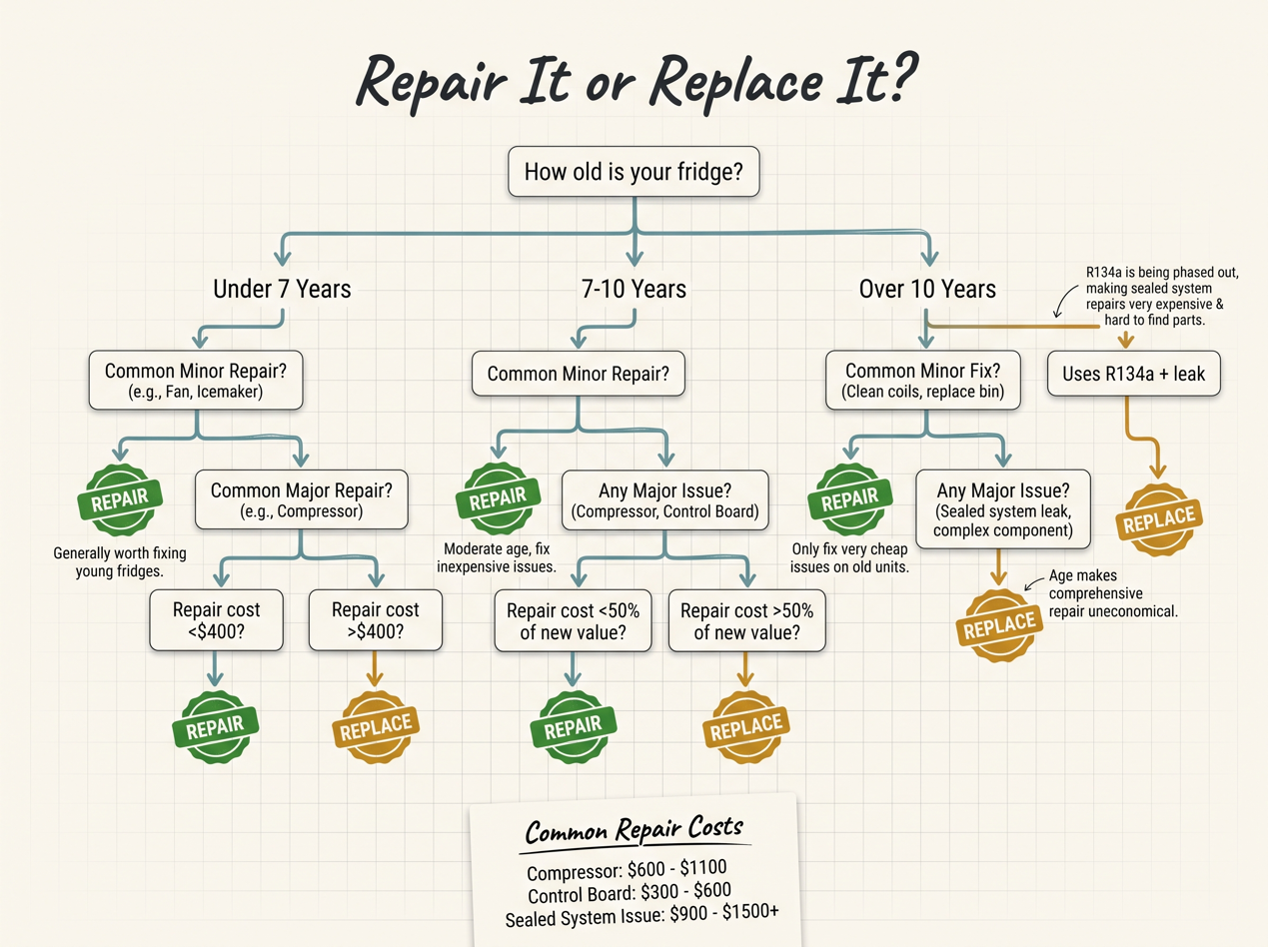
Condition gives a repair-cost guideline its context. Homa Appliances‘ replacement guide describes a 50 percent rule: a major repair quote above half a comparable replacement’s price points toward replacement. It is a rule of thumb, with age, fault severity and actual condition remaining relevant.
Using it in a refrigerator lifespan assessment involves understanding the repair under discussion. The ratio supplies one consideration within an account of the machine and its proposed repair.
A minor repair presents a different question from compressor, control-board or sealed-system work. These categories identify different scopes of intervention; their names alone do not establish the outcome for a particular appliance.
A written diagnosis locates the proposed work within that distinction. Age contributes another part of the account, alongside the machine’s present condition. Together these details explain why the significance of a repair quotation can vary between apparently similar cost comparisons.
The repair-versus-replace matrix discussed by Homa Appliances organizes age and repair categories into a decision framework. Its role is to make the relevant conditions visible.
The hypothetical percentage remains a calculation result, with no automatic matrix outcome assigned to it. The owner still needs to understand the actual diagnosis and how the appliance otherwise meets current needs. The framework helps organize those considerations into a reason that can be examined.
The Conditions Behind the Final Judgement
Remaining questions can concern the scope of the diagnosed work or the usefulness of continued operation to the owner. A refrigerator lifespan discussion can identify where each question affects the choice.
If the repair proposal leaves a diagnosed concern unexplained, that concern has a place in the reasoning. If the existing appliance no longer meets the owner’s needs, the replacement comparison needs to reflect that change. Each uncertainty qualifies a particular part of the decision.
The owner’s priorities give the condition assessment its practical purpose. A satisfactory existing appliance and a changed storage need present different reasons for considering replacement. The same quoted proportion cannot express that difference by itself.
Keeping the intended use alongside the diagnosis explains why one course might remain attractive under the stated conditions. After storage needs change, the appliance may remain unsuitable despite a repair directed at its fault; the cost ratio alone cannot determine suitability.
A judgement can change if the repair scope, the appliance’s condition or the owner’s intended use changes. Its explanation therefore needs to show which conditions support the chosen course and which remain unsettled. The proportion still performs its arithmetic task, while the diagnosis and comparison define what it concerns. A reason for repair or replacement combines that cost relationship with the actual condition and the usefulness sought from the appliance.