Printing enterprises serving corporate gifting, promotional merchandise, retail packaging, and customized consumer products face a common challenge: delivering consistent decoration across large orders while maintaining reasonable production costs. A commercial UV DTF printer offers a practical approach by combining digital color printing with film-based transfer technology. For businesses seeking greater product variety and premium finishes, this process can support scalable customization without requiring a separate printing setup for every item.
Flexible Decoration for Diverse Merchandise
Bulk merchandise orders rarely involve just one product category. Customers may request decorated phone cases, glassware, acrylic accessories, packaging labels, promotional gifts, and branded items in the same campaign. Traditional decoration methods can require different equipment or preparation procedures for different materials.
UV DTF printing produces designs on transfer film before they are applied to suitable surfaces. This separates image production from the final object, allowing print businesses to prepare transfers in batches and apply them when required. Substrate compatibility still depends on surface condition, material, and adhesive performance.
For commercial printers, this flexibility makes it easier to serve multiple customer segments without investing in dedicated equipment for every merchandise category. It also creates opportunities to offer customized designs across a broader product portfolio.
Consistent Quality Across Large Orders
Consistency becomes increasingly important as order quantities grow. Corporate customers typically expect logos, brand colors, text, and decorative details to remain visually uniform across merchandise supplied to different locations or distributed during large events.
A digital transfer workflow helps standardize artwork preparation and printing. Once a design has been approved, the same digital file can be reused for subsequent batches, reducing variation caused by repeated manual artwork preparation. Operators must still monitor ink delivery, film alignment, curing, and transfer application to maintain reliable results.
Repeat-order planning should account for ink configuration, film handling, substrate compatibility, and maintenance requirements.. These factors matter more to commercial buyers than headline specifications alone.
Premium Finishes Create More Business Opportunities
Visual differentiation is another reason printing enterprises invest in UV DTF technology. Customers ordering branded gifts, luxury packaging, cosmetics labels, and promotional merchandise increasingly look for decoration that makes products stand out from standard alternatives.
UV DTF printing can combine colorful graphics with white ink and varnish effects, depending on the machine configuration. Specialized systems can also incorporate metallic foil stamping, adding a premium appearance to selected designs. These effects allow print providers to develop differentiated merchandise packages rather than competing solely on price.
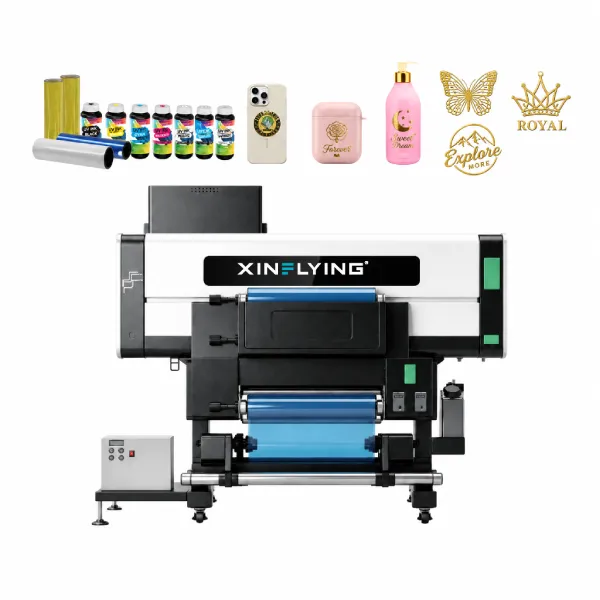
The Xinflying XF-600ST 24-inch Gold Stamping Solution All-in-One UV DTF Printer illustrates this approach. According to its official product information, the machine integrates color printing and gold foil stamping for premium labels, customized gifts, packaging, and high-end branding. This combination can help printing enterprises address customers who value decorative impact alongside personalization.
An Integrated Workflow Can Simplify Production
Bulk production depends on more than printing speed. Separate processing stages, frequent manual handling, and inconsistent material feeding can create bottlenecks that affect delivery schedules.
An integrated system can reduce the need to move materials between separate machines. The XF-600ST combines printing, foil transfer, waste discharge, and laminating in one automated workflow, according to Xinflying’s product description. Its large-capacity ink system includes stirring and low-ink alerts, while water-cooled UV curing lamps and intelligent bottom heating are designed to support stable operation.
The listed specifications include a 24-inch printing width, four Epson i3200-U1 printheads, and a stated six-pass productivity of 5.5 m²/h. These figures provide a starting point for production planning, but actual output depends on artwork coverage, settings, maintenance, and workflow conditions.
Before investing in a commercial UV DTF printer, buyers should test representative designs and calculate usable output per shift rather than assuming the advertised speed translates directly into finished merchandise.
Evaluate Total Cost and Production Reliability
Equipment purchasing decisions should consider the complete cost of producing a finished transfer. Relevant expenses include ink, transfer films, foil where applicable, maintenance, labor, rejected prints, and equipment downtime.
A wider printing format may allow more designs to be arranged across a production run, depending on their dimensions and layout. Automated processing may also reduce some handling requirements. However, these advantages should be assessed through actual job costing, including setup time and transfer application.
When comparing suppliers, businesses should ask a UV DTF printer manufacturer about consumable compatibility, maintenance schedules, operator training, spare parts, and technical support. Sample testing is equally important because adhesion and appearance vary with the receiving surface.
A realistic cost-per-transfer calculation helps determine whether the investment fits the company’s order volume, pricing model, and expected product mix.
Match Machine Capabilities to Commercial Demand
Not every printing enterprise needs the same production configuration. A business specializing in short personalized runs may prioritize design flexibility, while a packaging supplier handling recurring corporate orders may value automation, repeatability, and wider-format production.
The XF-600ST is worth evaluating for businesses targeting premium merchandise decoration that benefits from metallic finishes. Its integrated gold stamping function distinguishes it from configurations focused exclusively on standard color transfers.
Before selecting a supplier, buyers should compare demonstrated print quality, throughput under realistic conditions, service arrangements, and the availability of consumables. A capable UV DTF printer manufacturer should be able to explain which specifications matter for the buyer’s applications and help establish practical production expectations.
Choosing Equipment for Sustainable Business Growth
For printing enterprises, bulk merchandise decoration requires a balance of flexibility, consistency, production efficiency, and cost control. UV DTF technology can support varied customization projects while making it possible to prepare transfers separately from final product handling.
Xinflying provides digital printing solutions, including the XF-600ST, which combines a 24-inch printing format with integrated gold foil stamping. Businesses evaluating a commercial UV DTF printer should compare their order profiles, test representative substrates, and calculate total operating costs before purchasing. A well-matched system can help printing providers expand premium product offerings and build more dependable production workflows.