At the outlet of a diesel oxidation catalyst, the gas composition may have changed even though solid soot still travels with the exhaust. Downstream, a wall-flow filter redirects that stream through porous walls and retains particles. The difference between chemical conversion and physical capture explains why both devices can appear in one exhaust path without duplicating each other’s task.
Their order creates an interface. The upstream catalyst can change the amount of NO₂ available and the thermal condition reaching the filter. The filter’s soot load changes its pressure loss and regeneration need. A diesel particulate filter system is therefore evaluated over time, not only when the clean components are first fitted together.
Start with the Oxidation Stage
Oxygen reaching the coated channels supplies the oxidant for reactions of CO, hydrocarbons, and soluble organic fractions in the diesel catalyst. With suitable exhaust temperature and oxygen, these compounds undergo oxidation.
The DOC may also convert some NO to NO₂. That reaction changes the inlet mixture available to downstream equipment; it does not mean the DOC has captured the soot particles carried in the same flow.
NO₂ matters because it can oxidize deposited soot under suitable conditions, contributing to passive DPF regeneration. It can also change the NO/NO₂ balance relevant to fast-SCR behavior if an SCR unit is present. These are downstream possibilities, not guaranteed outcomes of every oxidation event.
Temperature, residence time, and the actual device order determine whether the useful reaction is available. A steady-load DOC result cannot show whether passive regeneration remains available during prolonged low-temperature operation on the engine.
An upstream temperature sensor does not automatically report the filter inlet temperature. Piping, mixing, and engine transients can change what reaches the second device. For integrated analysis, the DOC outlet and DPF inlet conditions need to be identified in the test layout. Their difference can explain why a promising bench result fails to appear in the assembled system.
Follow Particles through the Filter
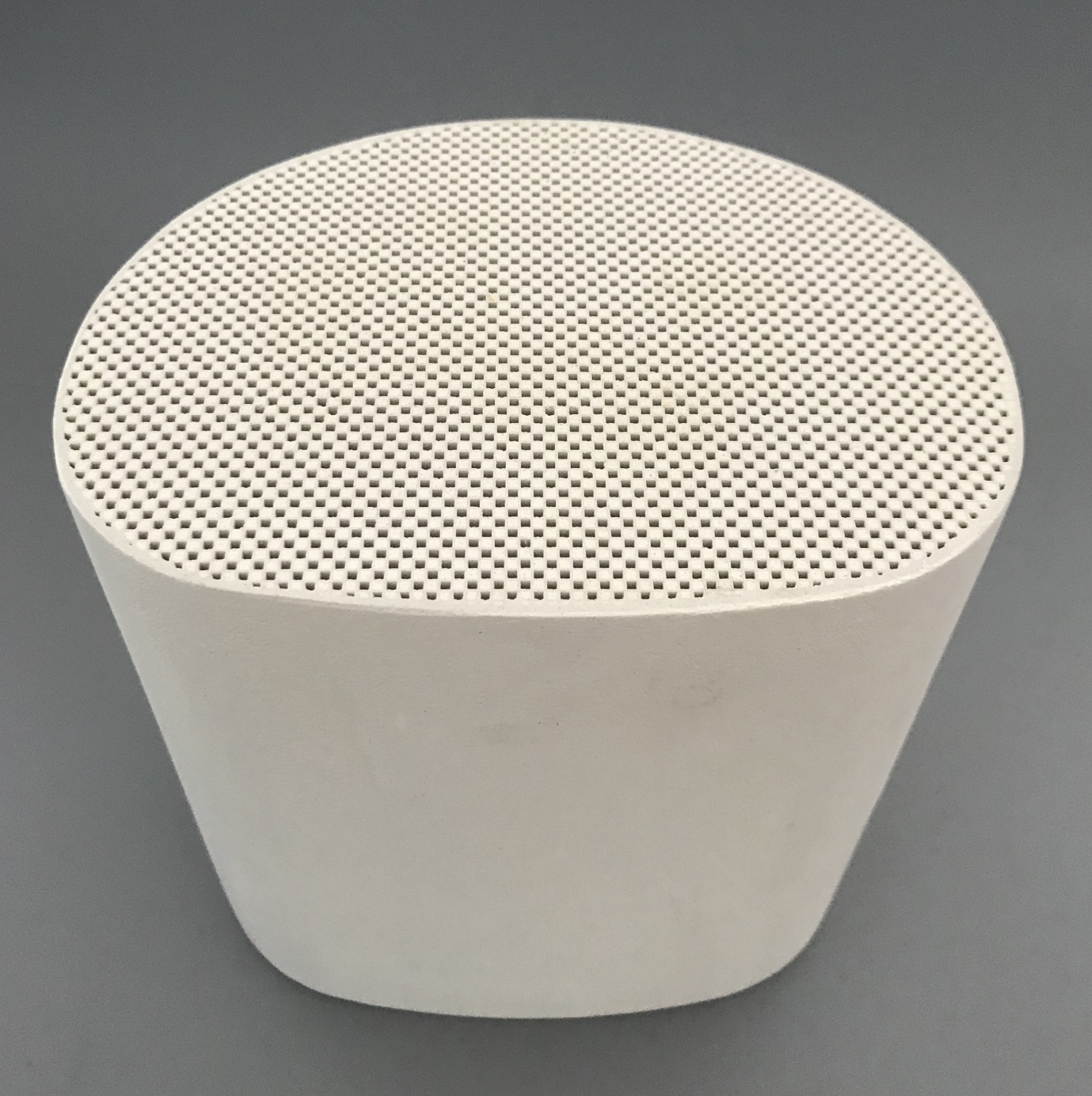
The diesel particulate filter system relies on wall-flow ceramic. Alternatingly closed channel ends direct gas through porous walls, leaving much of the particulate matter on or in the wall structure. Capture raises a second problem: accumulated soot increases restriction unless it is removed through a planned regeneration route.
Hualian Catalyst‘s paired DPF is offered with Cordierite or SiC wall-flow material, round or square forms, customizable dimensions, and 100–350 CPSI densities for Euro 4–6 diesel exhaust applications. Those are configuration options for matching the engine’s flow and installation envelope. A CPSI value does not, on its own, predict capture, loaded pressure, or regeneration behavior.
Cordierite and SiC respond differently to heat and mechanical stress, so material selection belongs with the expected regeneration temperature and packaging loads. Geometry also affects how much filter area is available and how exhaust is distributed. The housing must keep the core sealed; a bypass around the element defeats filtration even if the ceramic itself has adequate capacity.
Pressure across the filter changes with soot loading, ash accumulation, exhaust flow, and regeneration state. A clean-filter reading is therefore only the beginning of a service profile. Comparing pressure at matched flow and loading conditions distinguishes an intrinsically restrictive element from a temporarily loaded one. The engine’s total backpressure limit applies to the whole exhaust line.
The NO/NO₂ balance changes the oxidizing mixture delivered downstream. NO-to-NO₂ oxidation is among the stated DOC functions at Hualian, alongside oxidation of CO, HC, and soluble organic fractions. Outlet concentrations vary with coating, temperature, flow, and inlet composition. Measuring that mixture separates gas conversion from its contribution to filter regeneration.
Observe the Coupled Operating Cycle
Soot loading and exhaust temperature govern whether oxidation can offset deposits; otherwise, active regeneration supplies the needed heat. The DOC’s NO₂ output may assist the first route, but the relevant quantity is the NO₂ that actually reaches deposited soot. The filter’s pressure trend and regeneration response show whether that potential translates into restored flow capacity.
A diesel catalyst can also influence how much heat or oxidizing species arrives downstream. Those changes need to be read alongside filter material and the control strategy. If an active event raises temperature sharply, the filter and its housing face a different thermal exposure from ordinary operation. The combination must be checked rather than inferring durability from either component separately.
The test record should align engine load, DOC inlet and outlet conditions, DPF pressure, soot loading estimate, and regeneration state on one timeline. A change in NO₂ without a matching filter response is informative: some other condition may be limiting passive soot removal. A pressure reduction after regeneration is useful, but particulate capture still needs its own measurement.
The working relationship between a DOC and filter is visible in the changing material and energy streams between them. Oxidation can alter gas composition; filtration retains solids; regeneration clears part of the deposit at a thermal cost. An effective diesel particulate filter system keeps those effects within the engine’s emissions, pressure, and durability limits across its real duty, not just at a clean starting point.