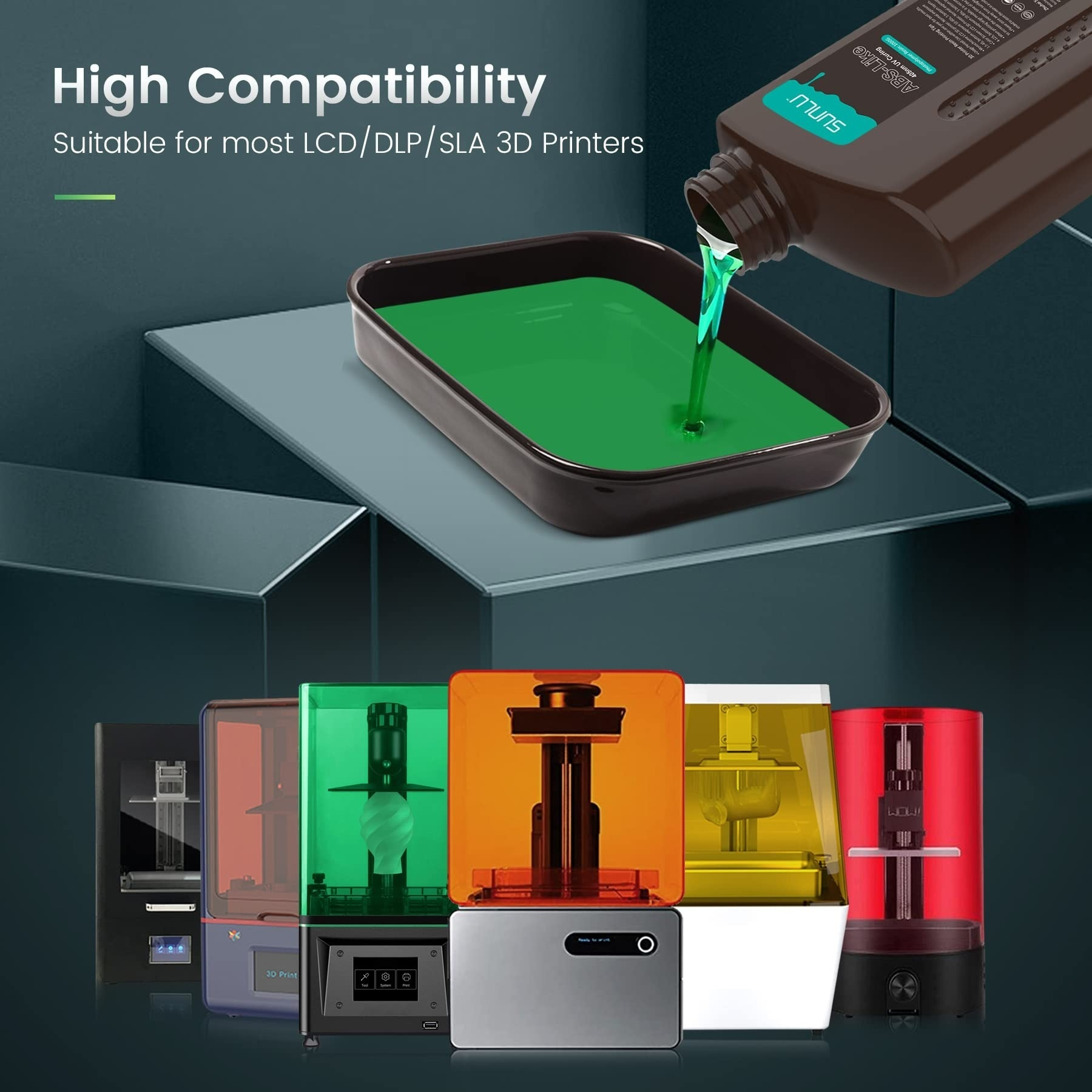
Choosing a 3d print resin involves more than comparing labels. Standard Resin is designed for everyday printing and detailed models, while ABS-Like Resin is formulated for greater toughness and impact resistance.
Neither option fits every project. The right choice depends on whether the part prioritizes rigidity, fine details, elongation, or the ability to handle occasional knocks during use.
What Is the Difference Between ABS-Like and Standard Resin?
Both are UV-curable photopolymer resins used in compatible resin printers, but their published mechanical properties point to different uses. Standard Resin has higher listed tensile strength, flexural strength, hardness, and heat deflection temperature.
ABS-Like Resin has higher elongation at break and impact strength, which can be helpful for models that may experience bending or sudden force.
This is the practical difference between abs like and standard resin: Standard Resin suits general-purpose parts where stiffness and detail are priorities, whereas ABS-Like is worth considering when toughness and impact response matter more. These are relative product characteristics, not a substitute for testing a finished part under its actual load.
How Do Their Mechanical Properties Compare?
The product-page specifications show how the two formulations differ.
| Property | Standard Resin | ABS-Like Resin |
| Tensile strength | 45 MPa | 28 MPa |
| Flexural strength | 57 MPa | 36 MPa |
| Elongation at break | 13.5% | 25% |
| Notched Izod impact strength | 40 J/m | 70 J/m |
| Heat deflection temperature | 55°C | 50°C |
| Shore hardness | 86 | 80 |
| Mold shrinkage | 8.9% | 8% |
These figures are supplier-listed measurements; compare them as an initial guide rather than a prediction of every print. Standard Resin’s higher tensile and flexural values may suit rigid models and display parts that need to hold their shape.
ABS-Like Resin’s higher elongation and impact-strength values make it a candidate for assemblies, enclosures, and prototypes exposed to handling. Print orientation, geometry, exposure, and post-curing all affect finished-part behavior.
When Should You Choose Standard Resin?
Standard Resin suits everyday models, miniatures, decorative objects, and visual prototypes where surface detail and rigidity are important.
It also comes in multiple solid and transparent-tinted colors, offering flexibility for display pieces and concept models. The formulation is positioned for smooth flow and straightforward printing, which can be useful for routine projects.
For example, a tabletop miniature or presentation model may benefit more from crisp details and consistent appearance than from extra impact resistance. A functional part still needs evaluation against the expected load and temperature.
The resin’s listed heat deflection temperature is 55°C, so consider the environment before using it near heat sources.
If the main goal is appearance rather than repeated mechanical loading, this formulation provides a straightforward route for comparing proportions, surface details, and color choices across iterations. The resulting model can guide design revisions before moving to a resin with different performance priorities.
When Is ABS-Like Resin a Better Fit?
ABS-Like Resin is worth evaluating for functional prototypes, snap-fit concepts, small enclosures, and model parts that may encounter occasional impact. Its listed 25% elongation at break and 70 J/m notched Izod impact strength are higher than Standard Resin’s corresponding values.
These properties suggest more capacity for deformation and impact under the specified tests, though they do not mean every shape will be resistant to breakage.
The trade-off is that the listed tensile and flexural strength values are lower than Standard Resin’s. For load-bearing or safety-critical components, test the completed part in its real configuration instead of relying on resin names or a single data point.
Neither resin should be treated as a direct replacement for injection-molded ABS without application-specific validation.
Do the Resins Need Different Printing Settings?
Both formulations need exposure settings matched to the printer and resin color. SUNLU lists these starting ranges on its product pages:
| Setting | Standard Resin | ABS-Like Resin |
| Bottom layers | 5–10 | 5–10 |
| Bottom exposure, color LCD | 20–70 s | 20–80 s |
| Bottom exposure, monochrome LCD | 10–50 s | 10–60 s |
| Layer exposure, color LCD | 4–15 s | 4–15 s |
| Layer exposure, monochrome LCD | 1.5–3.5 s | 1.5–3.5 s |
These ranges are starting points, not universal presets. Printer model, layer height, color, and light output can change the exposure needed. Run a calibration print when changing resin, then assess detail, layer adhesion, and support performance. Follow the product’s current instructions if the listed parameters change.
How Can You Choose the Right Resin?
Start with the demands of the finished part. Choose Standard Resin for detailed everyday prints where rigidity and appearance are priorities. Consider ABS-Like Resin for parts that benefit from greater elongation and impact resistance.
Compare the technical data alongside working temperature, shape, wall thickness, support layout, and post-curing conditions.
SUNLU provides specifications for both formulations to help narrow the selection. Print a representative sample, record the settings, and test it under realistic handling and temperature conditions before committing to a functional design.
The better choice is the resin whose measured behavior matches the application’s needs, not necessarily the one with the highest value in a single category.