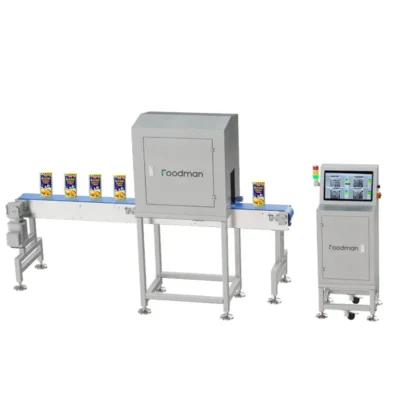
Foreign objects inside food are not always visible from the outside of a package. A sealed product may contain metal fragments, glass, stones, or other dense materials that cannot be identified through ordinary visual inspection.
A food X-ray machine addresses this problem by examining differences in X-ray absorption as products pass through the inspection system.
The technology is therefore useful for more than finding one specific type of contamination. Depending on the system, product, and packaging, X-ray inspection can identify a range of foreign objects and support additional checks such as bone detection, fill-level inspection, and fat analysis. Foodman provides X-ray systems for packaged, bulk, canned, pumped, and product-specific applications.
What Makes a Contaminant Visible to X-Ray Inspection?
X-ray inspection does not identify contamination simply because an object is “foreign.” Its detection capability is based largely on differences in density and how materials absorb X-rays. A contaminant that creates a sufficient contrast against the surrounding food can appear in the X-ray image even when it is hidden inside the product or packaging.
That principle gives X-ray inspection an important role in packaged food production. The inspection does not depend on opening the package, so sealed products can be examined before they leave the production line.
Detection conditions vary with food composition, contaminant size, package dimensions, and system configuration. Consequently, processors should evaluate detection capability using their actual products and packaging rather than assuming that every X-ray machine provides identical results.
Metal Is Only One Part of Foreign-Object Detection
Metal fragments are a familiar food-safety concern, but X-ray inspection can address foreign materials beyond metal. Foodman’s packaged-product systems are described for foreign-object detection across food, pharmaceutical, light-industry, and packaged products.
This makes X-ray inspection useful when a production line faces several possible contamination sources. Equipment wear can introduce fragments, raw materials can carry unwanted particles, and packaging or processing environments can create additional risks.
A separate metal detector remains valuable for applications centered on metal contamination. X-ray inspection, however, can provide a broader material-density perspective. The appropriate technology depends on the hazard profile and the physical characteristics of the product being inspected.
Glass, Stone, and Dense Materials Inside Food
Glass and stone are important examples of contaminants that can be difficult to identify through external visual checks. A package can appear intact while a dense foreign object remains hidden within its contents.
Foodman’s current X-ray technology includes dual-energy detection designed to identify contaminants across complex materials and multilayer packaging. Its published capabilities specifically include glass detection.
Bulk foods can present a different inspection scenario because individual products may not be enclosed in uniform packages. Foodman’s applications include rice, beans, nuts, and seeds, with X-ray systems described as suitable for detecting foreign objects in bulk products.
The actual detection result still depends on the relationship between the contaminant and the food matrix. A practical evaluation should therefore use representative production samples rather than relying only on a general material list.
How X-Ray Systems Handle Bones and Product-Specific Risks
Bone detection illustrates why food X-ray inspection often needs to be matched to a specific application. Poultry and meat processors may need to identify remaining bone fragments after deboning, while seafood processors may face similar concerns in fish products.
Foodman’s product range includes dedicated X-ray inspection systems for bones, and its website identifies bone recognition as one capability of its advanced dual-energy detection technology. Its seafood applications include shrimp, crab, squid, and scallop, while meat and poultry applications cover beef, pork, lamb, and chicken.
These applications show why inspection requirements cannot be reduced to a universal contaminant checklist. The density of the target material, the surrounding food, product thickness, and processing format can all affect the inspection challenge.
Can X-Ray Inspection Check More Than Foreign Objects?
Foreign-object detection is a major use, but it is not the only inspection function available from X-ray technology. Foodman’s product portfolio includes X-ray systems for canned products, pumped products, and fat analysis in addition to packaged and bulk inspection.
Beverage applications provide another example. The company describes X-ray inspection for bottled drinks that can support contaminant and fill-level detection. This makes the technology relevant not only to food safety but also to certain product-quality checks.
Inspection data can also contribute to production traceability. Foodman’s platform includes image recording, data storage, statistical reporting, and batch tracking, allowing inspection information to become part of a broader quality-management workflow.
Why the Product and Packaging Determine Detection Capability
A food X-ray machine should never be selected from a contaminant list alone. Product density, package material, package dimensions, production speed, and the type of foreign object all influence the inspection task. A system designed for packaged snacks may require different configuration considerations from one handling bulk nuts, bottled beverages, poultry, or pumped foods.
Foodman Vision offers systems covering packaged products, bulk materials, canned products, pumped products, and specialized bone inspection. Its stated use across snacks, meat and poultry, seafood, beverages, fruits and vegetables, cheese, dairy, and other food categories reflects the need for application-specific inspection.
For processors, the most useful question is therefore not simply whether X-ray can detect a particular contaminant. The better question is whether the selected system can reliably distinguish that contaminant from the specific food and packaging under actual production conditions. Foodman supports product testing and solution assessment for customers that are uncertain about the appropriate model or configuration.
A well-matched X-ray inspection system can detect a broad range of dense foreign objects, including metal, glass, and other contaminants, while specialized configurations can address bones, fill levels, and additional product characteristics. The final detection capability depends on the complete inspection setup, making product-specific testing an essential step before equipment selection.