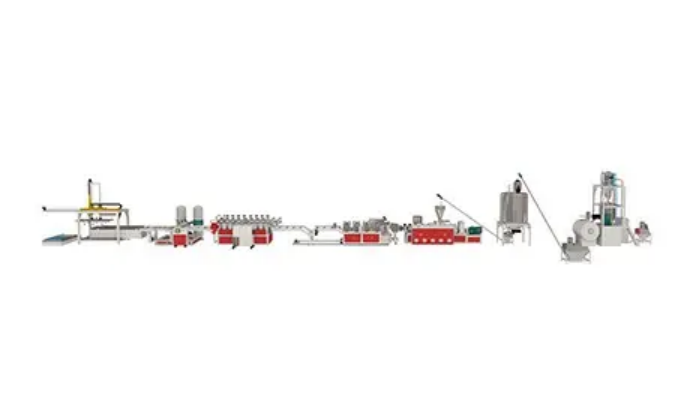
In the manufacturing of cellular PVC, thermal management extends far beyond the heating bands on the extruder barrel. Within a PVC foam board production line, a significant portion of the energy used to melt the polymer comes from mechanical work, known as “shear heat.” For B2B manufacturers producing boards ranging from 3mm to 30mm in thickness, controlling this internal heat is the difference between a uniform, fine-celled structure and a degraded, discolored product.
The Physics of Shear Heat in PVC Foaming
Shear heat is generated by the friction between the PVC molecules, the filler particles (such as calcium carbonate), and the metal surfaces of the twin screws. In a PVC foam board extrusion line, the high viscosity of the PVC melt means that as the screws rotate, the mechanical energy is converted into thermal energy. If the screw speed is too high or the screw geometry is too aggressive, the melt temperature can “overshoot” the set point, even if the external heaters are turned off.
This is particularly critical in foaming because the decomposition of the chemical blowing agent is temperature-dependent. Excessive shear heat can cause the blowing agent to trigger prematurely or unevenly, leading to large, irregular voids or “collapsing” of the foam structure. To maintain a consistent density—typically between 0.4 and 0.8 g/cm³—the extruder must balance the screw RPM with an active internal cooling system to dissipate this kinetic energy.
Advanced Thermal Control by Boyu
For industrial-scale operations, equipment must provide precise feedback loops to manage these thermodynamic challenges. Boyu engineers their PVC foam board production line with specialized conical twin-screw technology, such as the SJSZ-80/156 or SJSZ-92/188 series, which are optimized for low-shear, high-output processing. Their screws are designed with specific flight geometries that maximize homogenization while minimizing the risk of localized overheating.
To ensure stability, their PVC foam board extrusion line features advanced oil-cooling systems for the internal screw cores and highly responsive air or water cooling for the barrel zones. By utilizing Omron temperature control meters and Siemens PLC interfaces, they allow plant operators to monitor and adjust torque and melt temperature in real-time. Their systems are built to handle the rigorous demands of 24-hour B2B production, ensuring that their partners achieve the smooth surface finish and consistent mechanical properties required for construction and advertising applications. Through these precision engineering standards, they help clients minimize material waste and maximize the service life of their extrusion components.